

The Oldest Dollars, Worked First: A/R Follow-Up Software
Collectors lose the morning deciding which claim to call first. A/R follow-up software hands each of them a ranked worklist and tracks results weekly.
A/R Follow-Up and Secondary Claims
A/R follow-up is the daily work of chasing insurance claims the payer has not paid: checking status, calling or using the payer portal, fixing what blocks payment and logging the next date. A/R follow-up software ranks each collector's claims by age and balance and records every touch, so the oldest dollars get worked first.
- What the Step Is
- Collectors follow up on claims the payer has not paid. They call payers, check portals and resubmit. After the primary pays, the secondary payer gets its claim.
- Where It Breaks
- Aging reports run monthly and go stale in days. Collectors pick claims by habit, not by value. Secondary claims wait without the primary EOB attached.
- What We Automate
- A/R aging by payer and bucket.
- A worklist for each collector, ranked by balance and age.
- A weekly scorecard of follow-up results.
- A secondary queue with the primary EOB attached.
- How Claims Age
- A claim ages from its date of service. HFMA's MAP Keys group physician A/R by age in five bands: 0-30, 31-60, 61-90, 91-120 and over 120 days. AR-1 reports each band as a share of total billed A/R.
- What to Work First
- Work claims in order of their next follow-up date, then by priority, which weighs balance and age. A claim with a later follow-up date leaves the list until that day.
- What a Follow-Up Records
- Each touch records the action, the status the payer gave, the next step and the date to check again. A call also records the rep's name, phone number and any call reference, so the next person can pick up the claim.
- When the Secondary Gets the Claim
- The secondary gets the claim after the primary has paid and its remittance is in, because it needs the primary's payment and adjustments. When Medicare is primary, check that remittance for a crossover first: Medicare may already have sent the claim to the supplemental plan.
Try the Claims and A/R Workspace
A/R aging by payer and bucket, a collector worklist, a weekly scorecard and a secondary queue with the primary EOB attached.
What This Screen Does
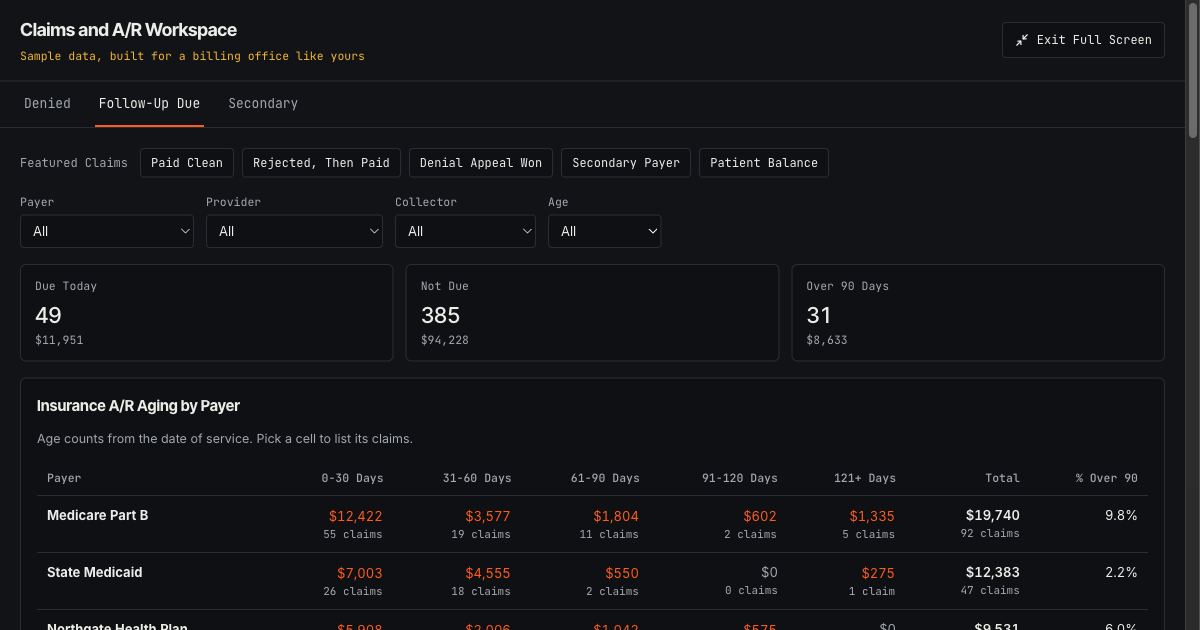
- An aging board: every payer by age group, in dollars and claims, with the share over 90 days.
- A worklist ordered by follow-up date, then priority, then age.
- A follow-up form: action, payer rep and phone for calls, status, and a next date from the action's rule.
- A secondary queue with the primary EOB beside each claim and crossovers marked.
- A weekly scorecard against our targets, with the share of measures on target.
- A team view that reassigns claims between collectors.
Questions Billing Teams Ask
What Is A/R Follow-Up?
It is the work of getting paid on claims that are billed but still open with the payer. A collector checks where each claim stands, contacts the payer by phone or portal, fixes what is blocking payment and sets the date to check again.
What Share of A/R Over 90 Days Is a Warning Sign?
There is no published industry target. HFMA's MAP Keys measure aged A/R as a share of total billed A/R in five groups, from 0-30 days to over 120, counted from the date of service for physician practices, but publish no benchmark. Set your own target and watch the weekly trend. Our sample scorecard uses targets we chose.
How Often Should You Follow Up on an Unpaid Claim?
Set the next date from what the payer told you: a claim in process gets a later recheck than one missing information. When there is no answer yet, a fixed recheck interval keeps every claim moving. Our sample uses 14 days.
What Should You Record After a Payer Call?
The rep's name and phone number, a call reference if given, the status the payer reported, what you will do next and the date to check again. That record lets anyone on the team pick up the claim without calling again.
When Should You Bill the Secondary Payer?
After the primary payer has paid and you have its remittance, since the secondary needs the primary's payment and adjustments to work out its share. Coordination of benefits rules decide which plan pays first. When another plan is primary to Medicare, CMS says that plan may have to pay before Medicare.
What Is a Crossover Claim?
A claim Medicare sends on to a supplemental plan itself, under a coordination of benefits agreement that plan signed with CMS. CMS runs this crossover through its Benefits Coordination and Recovery Center. Check the primary remittance first: billing the secondary yourself after a crossover creates a duplicate.
Part of Denials, A/R & Posting
Show Us the Workflow That Slows Your Team Down
One working session. You walk us through it, we tell you what we'd build and how long it takes.
Book a Working Session