

Never Miss an Appeal Deadline With Claim Appeals Software
Every payer sets its own appeal deadline. We build claim appeals software that ranks denials by amount and deadline, then drafts the letter.
Denials and Appeals
To appeal a denied claim, read the denial codes, confirm the payer's appeal deadline, fix what can be fixed, and send a written appeal with the records that answer the denial reason. Claim appeals software keeps each denial, its deadline and its letter on one screen, so nothing ages past the payer's limit.
- What the Step Is
- A denial means the payer refused to pay the claim. Some need a corrected claim. Others need a written appeal before the payer's deadline.
- Where It Breaks
- Denials pile up with no order of work. Appeal letters start from a blank page. Deadlines pass and the money is gone.
- What We Automate
- A denial worklist sorted by category, age, amount and deadline.
- A denial rate trend for each payer.
- An appeal builder: pick a template, fill it, preview the letter.
- Reminders as appeal deadlines approach.
Try the Claims and A/R Workspace
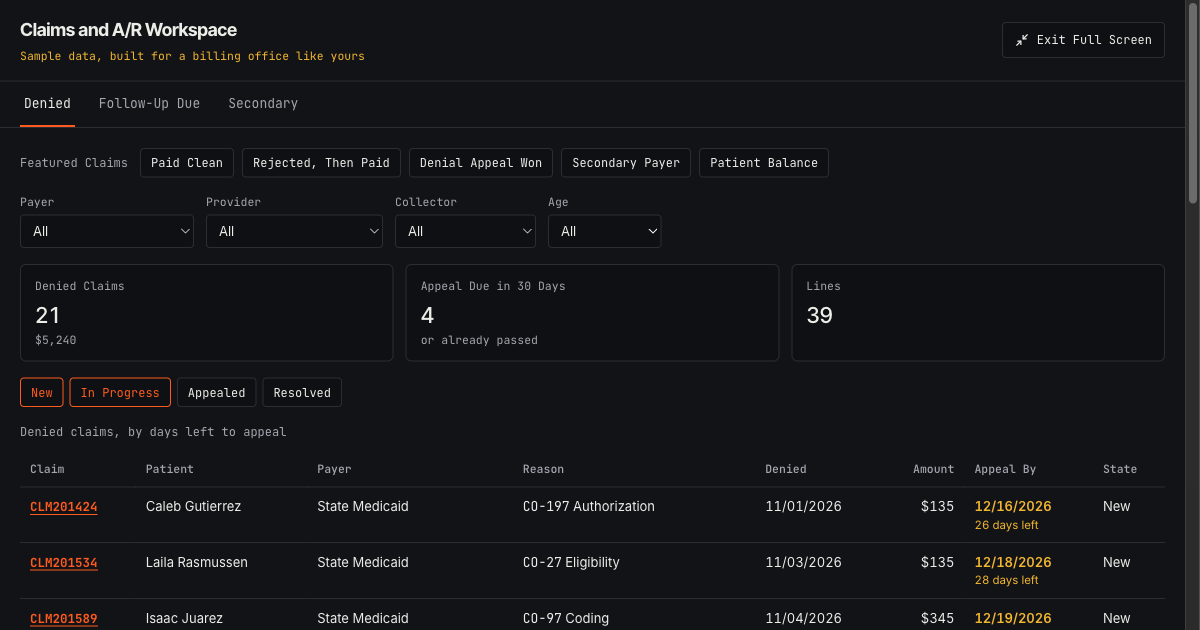
A denial worklist by category, age, amount and deadline, a denial rate trend by payer and an appeal builder that previews the letter.
What This Screen Does
- A denied claims worklist sorted by days left to appeal, with a warning inside 30 days.
- A denial card for each denied line: codes as printed, denial date, deadline, cause and state.
- An appeal letter builder that picks the letter for the denial cause and fills it from the claim.
- Correct and resubmit for denials that are fixed and sent again, not appealed.
- A six-month denial rate trend for the top payers, against our 5% target.
Questions Billing Teams Ask
What Are the Most Common Reasons Claims Are Denied?
Most denials trace to a short list of causes: wrong patient or coverage details, no prior authorization, coding the payer disputes, medical necessity, late filing, missing records and duplicates. Each denial carries a claim adjustment reason code (CARC), and often a remark code (RARC), from the public code lists X12 maintains, so the cause can be read from the remittance.
How Long Do You Have to Appeal a Denied Claim?
Each payer sets its own limit in its contract or provider manual. For traditional Medicare, CMS allows 120 days from receipt of the initial determination to request a redetermination, and treats the notice as received 5 calendar days after its date. Track every denial against its own payer's limit, counted from the denial date.
What Goes in an Appeal Letter?
The patient, member ID, claim number, dates of service and the lines you are appealing. Then the denial code, a plain explanation of why the decision is wrong, and the records that prove it: visit notes, the authorization or proof of timely filing. For Medicare, CMS lists what a written request must include, among them the specific services, the dates and why you disagree.
How Should a Denial Worklist Be Sorted?
By days left before the appeal deadline, fewest first, then by amount. Denials with no deadline go last. Sorting by age alone hides the claim that expires this week behind older ones with months to spare.
When Should You Write Off a Denial Instead of Appealing?
When the deadline has passed, when the payer's reason is right and cannot be fixed, or when the amount is smaller than the cost of the appeal. Some denials, such as eligibility errors and duplicate claims, are corrected and sent again rather than appealed.
Part of Denials, A/R & Posting
Show Us the Workflow That Slows Your Team Down
One working session. You walk us through it, we tell you what we'd build and how long it takes.
Book a Working Session